


Most of us treat a pair of glasses as a lens problem. A smudge appears, you breathe on the glass, wipe it on a shirt or a microfiber cloth, and slide the frames back on. The lenses look clear, so the job feels finished. But the parts of your glasses that touch your skin all day, the nose pads and the tips that wrap behind your ears, rarely get the same care. A 2018 study that swabbed everyday eyeglasses suggests those are exactly the spots where bacteria concentrate.
Your lenses are clean. Your frames are not.
There is a quiet gap between the way most people clean their glasses and the way the glasses actually get dirty. We wipe the lenses because a smudge is visible and mildly annoying. The frames, by contrast, rarely announce themselves. They rest against the skin, pick up oil and moisture, get adjusted with unwashed hands, and are set down on desks, gym bags, car seats, and nightstands. None of that shows up as a smudge, so none of it triggers the urge to clean.
That gap matters because the skin-contact points on a pair of glasses are warm, slightly oily, and constantly re-inoculated, which is a comfortable environment for the same bacteria that normally live on human skin. The lenses, wiped over and over, tend to carry the lowest load. The frames, wiped almost never, tend to carry the highest. The habit is not wrong so much as it is lopsided: we clean the part we look through and ignore the part that touches us.
What actually lives on a pair of glasses
In 2018, researchers in Germany swabbed 21 pairs of worn eyeglasses, half from university students and half from nursing home residents, and cultured what they found. The result was unambiguous. Every single pair carried bacteria, 100 percent of the 21 spectacles sampled. The heaviest loads were measured on the nose pads and the ear pieces, the surfaces that press directly against the skin, while the lenses carried the least.
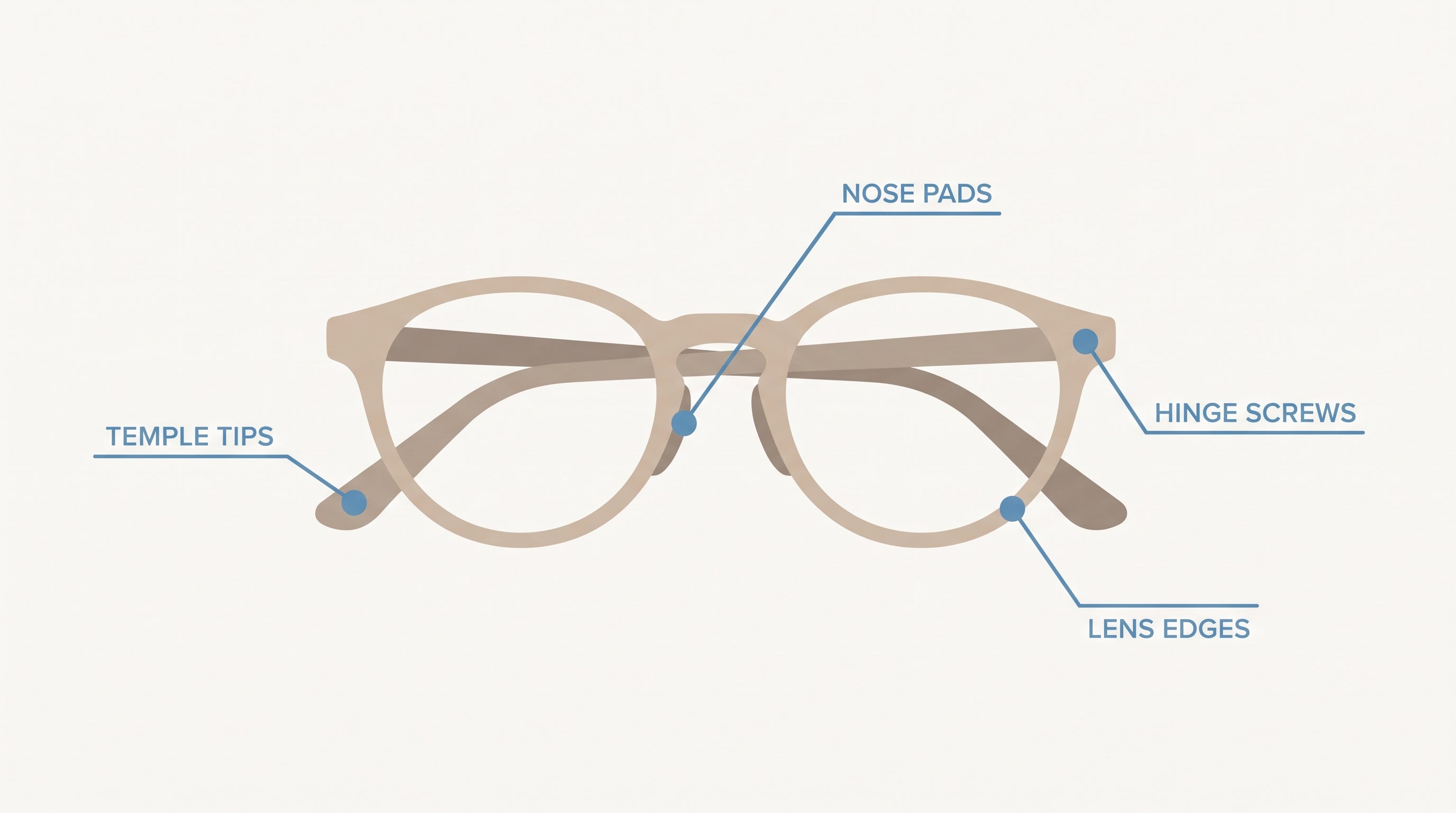
The most common genus by far was Staphylococcus, with Staphylococcus epidermidis, a normal resident of human skin, as the dominant species. Staphylococcus aureus, a species that can cause skin and wound infections, was detected as well. The authors noted that 60 percent of the bacterial isolates from the student glasses, and 64 percent from the nursing home glasses, belonged to a category classified as potentially pathogenic. In plain terms, a pair of glasses is not a sterile object, and most of what collects on it concentrates exactly where people forget to clean.
The study's authors were direct about what this means. Spectacles, they wrote, can act as fomites, objects that carry microbes from one surface to another, and a routine that wipes only the lenses does little to address the frames. The reassuring part is that the fix is simple, and it is mostly a matter of attention.
Why a dry wipe does not finish the job
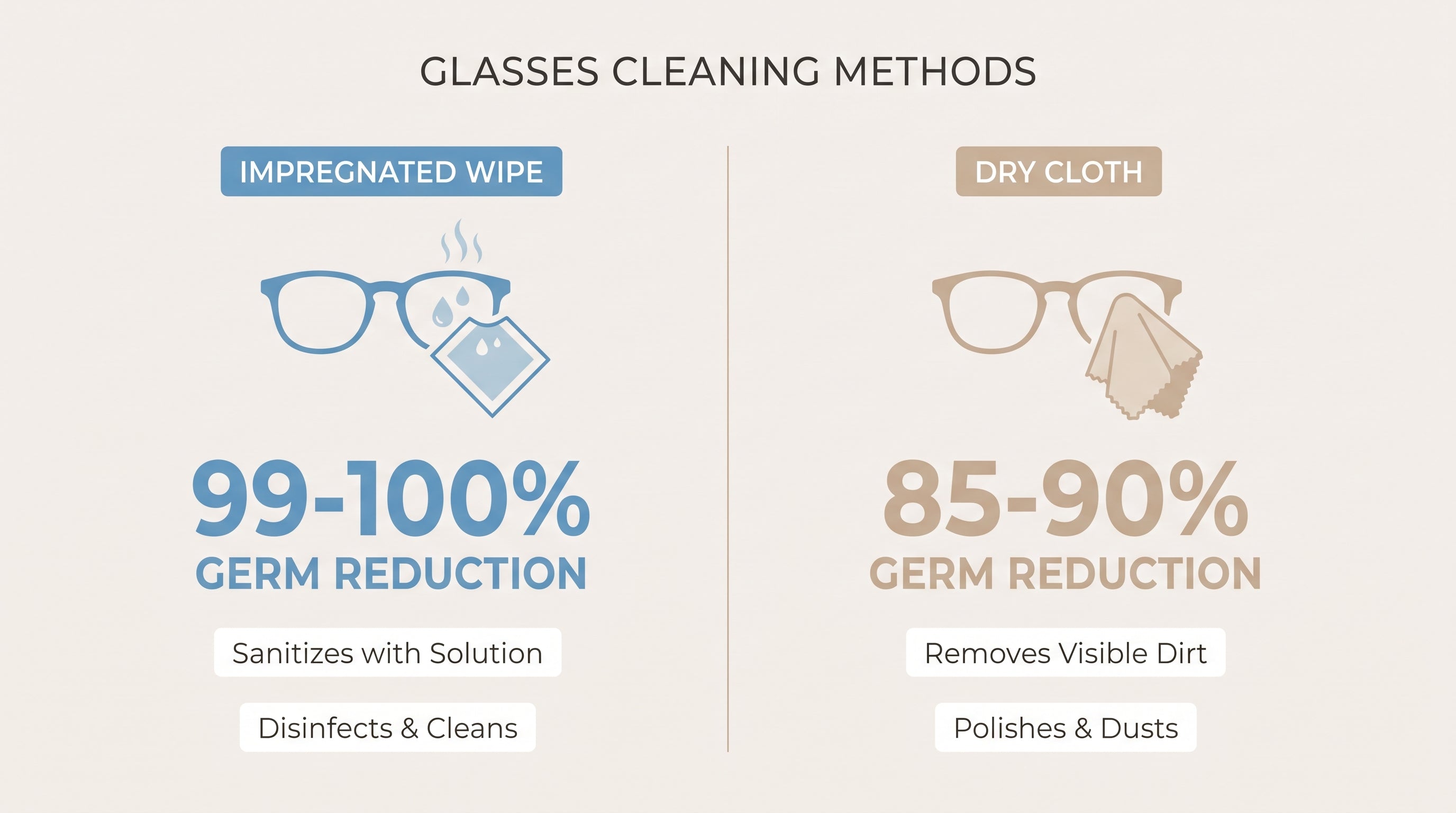
The same study tested what actually reduces that load, and the results explain why the everyday dry wipe falls short. Impregnated lens wipes, the pre-moistened cloths sold in small packets, delivered a median reduction of 99 to 100 percent of the bacteria. Dry cleaning with a microfiber cloth or a tissue managed only 85 to 90 percent. The difference was statistically significant. The dry methods we reach for out of habit are fine for fingerprints and smudges, but they smear and redistribute far more than they remove.
It also helps to separate two ideas that are easy to collapse into one. Cleaning removes dirt and some germs with soap or detergent and a little friction. Disinfecting is a separate step that kills germs on a surface. The CDC's home hygiene guidance keeps this calm and practical: for routine, everyday life, plain cleaning is usually enough, and disinfecting matters most when someone in the home is sick or has a weakened immune system. Whichever route you take, the order is the same. Clean first, because a layer of dirt can shield germs from whatever comes next.
For the parts of a pair of glasses a cloth cannot fully reach, a quick extra pass is what closes the gap between looking clean and being clean. See how UVCeed adds that pass.
A simple routine that actually covers the frames
A practical routine does not need to be elaborate, and it does not need to turn a bathroom into a lab. The goal is simply to stop treating the lenses as the whole job. Here is a sequence that takes under a minute and covers the places the old habit skipped.
Start by washing your hands, since the point is to remove bacteria rather than add more. Rinse the glasses under lukewarm water to lift dust, which would otherwise scratch the lenses as you rub. Then work a small drop of gentle dish soap over the lenses, the nose pads, and the full length of both arms, including the tips that sit behind your ears. Rinse again and pat dry with a clean cloth, or let them air dry. Keep the microfiber cloth for lenses only, and wash that cloth regularly too, because a dirty cloth simply moves grime around rather than removing it.
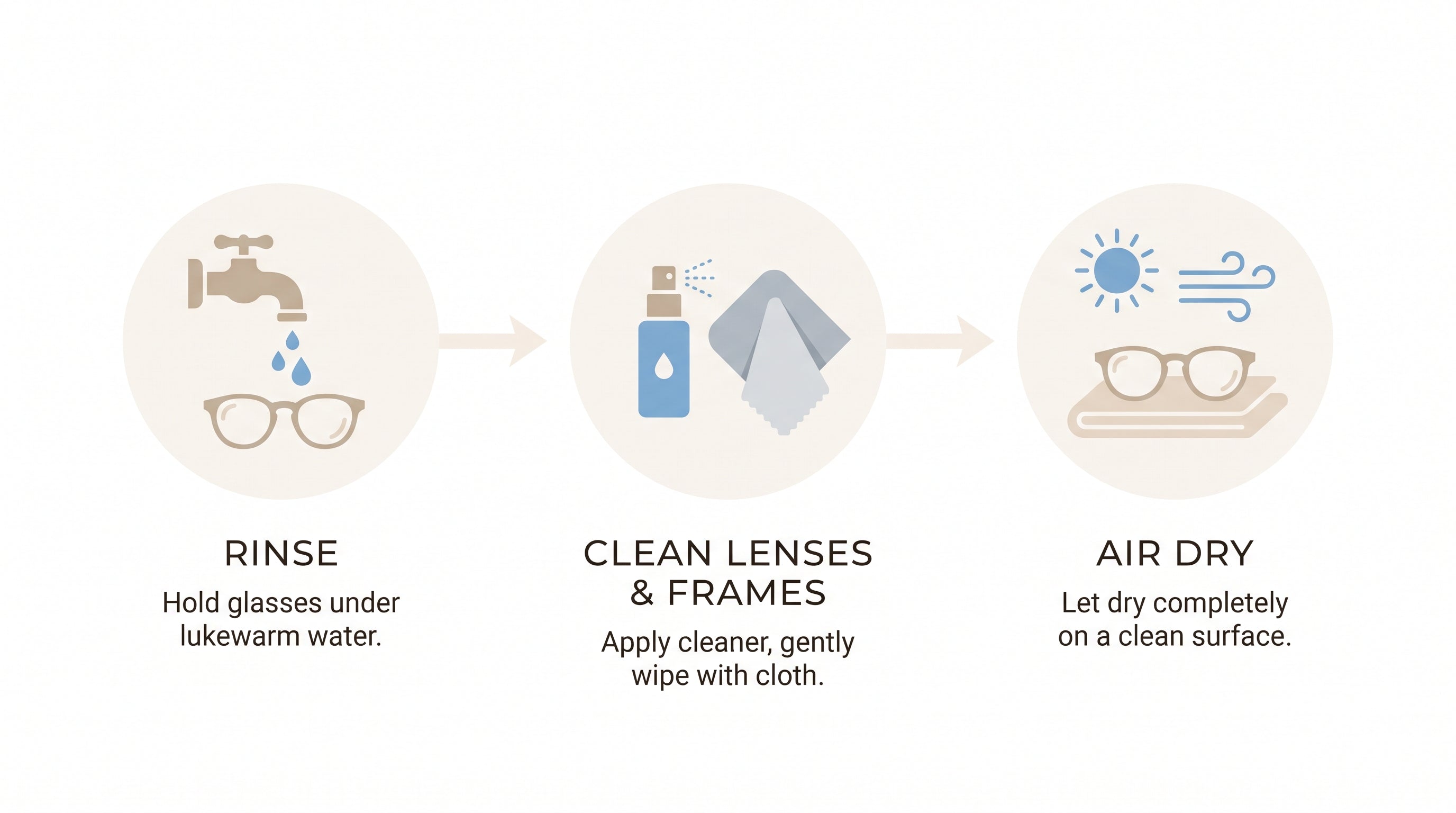
The frame gets the same treatment as the lens, and once the habit is familiar it takes no longer than the old one. What changes is the fraction of the object you actually clean.
When you want to disinfect, not just clean
There are moments when cleaning is not quite enough: when someone in the house has been sick, when glasses have spent time on a gym bag or a shared desk, or when they belong to a child who touches their face constantly. That is where a disinfection step earns its place.
Ultraviolet-C, or UV-C, is one option, and its basic mechanism is easy to understand. UV-C light damages the DNA and RNA inside bacteria and viruses, which stops them from multiplying. The Food and Drug Administration describes UV-C as a known disinfectant for air, water, and nonporous surfaces. The important caveat is that UV-C is line-of-sight: it only treats the surfaces the light can actually reach. A shadowed spot, the inside of a hinge, or the fold under a nose pad gets little or no dose unless you deliberately move the light across it.
That is where guidance makes the difference. UVCeed works through your phone, and the app uses the camera to show you, in real time, which parts of a pair of glasses have been covered and which still need a pass, so the shadowed spots do not get skipped by guesswork.
If you would rather see the coverage than trust a blind pass, UVCeed turns the phone you already carry into the disinfection tool: See the UVCeed disinfection device.
Small habits that keep frames cleaner longer
A few low-effort habits reduce how much collects on glasses in the first place. Set glasses down on a clean surface instead of a gym bag or a shared table. Stop wiping the lenses on clothing, which transfers oil and lint right back onto the glass. Give the nose pads and temple tips a quick daily wipe even when the lenses look fine. And if the glasses live in a case, clean the case now and then too, since a closed, warm case is exactly the kind of spot bacteria prefer.
None of this asks for a clinical routine. The point is closer to the way any good product becomes a good habit: small, repeatable, and attached to something you already do every day, so it sticks without effort.
The takeaway
The most useful change here is a shift in attention. A pair of glasses is not really a lens with some hardware attached; it is a personal item that spends the whole day in contact with your skin, your hands, and the world around you. Cleaning only the lenses is like washing only the part of a dish you can see. Once the frames, nose pads, and ear pieces join the routine, the daily habit takes no longer and covers far more of the object you actually carry on your face.
Want More Articles Like This?
Get research on UV-C treatment and product updates delivered to your inbox.


