


You wipe the kitchen counters, run the dishwasher, and swap the bathroom towels on a schedule. Then you get in your car, wrap both hands around the steering wheel, and drive to work on a wheel that has probably not been disinfected in months, if it ever has been at all. This is not a criticism. It is a blind spot almost everyone shares, because a car does not look dirty and it does not come with a reminder.
The problem is that a car is not simply a machine you sit inside. It is a room you live in every single day. You eat in it, cough in it, drive home from the gym in it, and pass your phone, keys, and coffee through it. Each of those small moments leaves something behind on the handful of surfaces your hands touch most, and those surfaces are almost never the ones we clean.
Here is what researchers actually found when they swabbed real car interiors, why a quick wipe often is not enough, and a simple order for cleaning the high-touch spots you probably skip.
The car is a room you live in
Think about how many objects you touch more often than your steering wheel. Your phone, maybe. Your keyboard, probably. The steering wheel belongs right there with them, and unlike those two, it also lives inside a space that is rarely cleaned end to end. For many people, the car is the second most-occupied room of the day, behind only the home, yet it gets a fraction of the attention we give the kitchen or the bathroom.
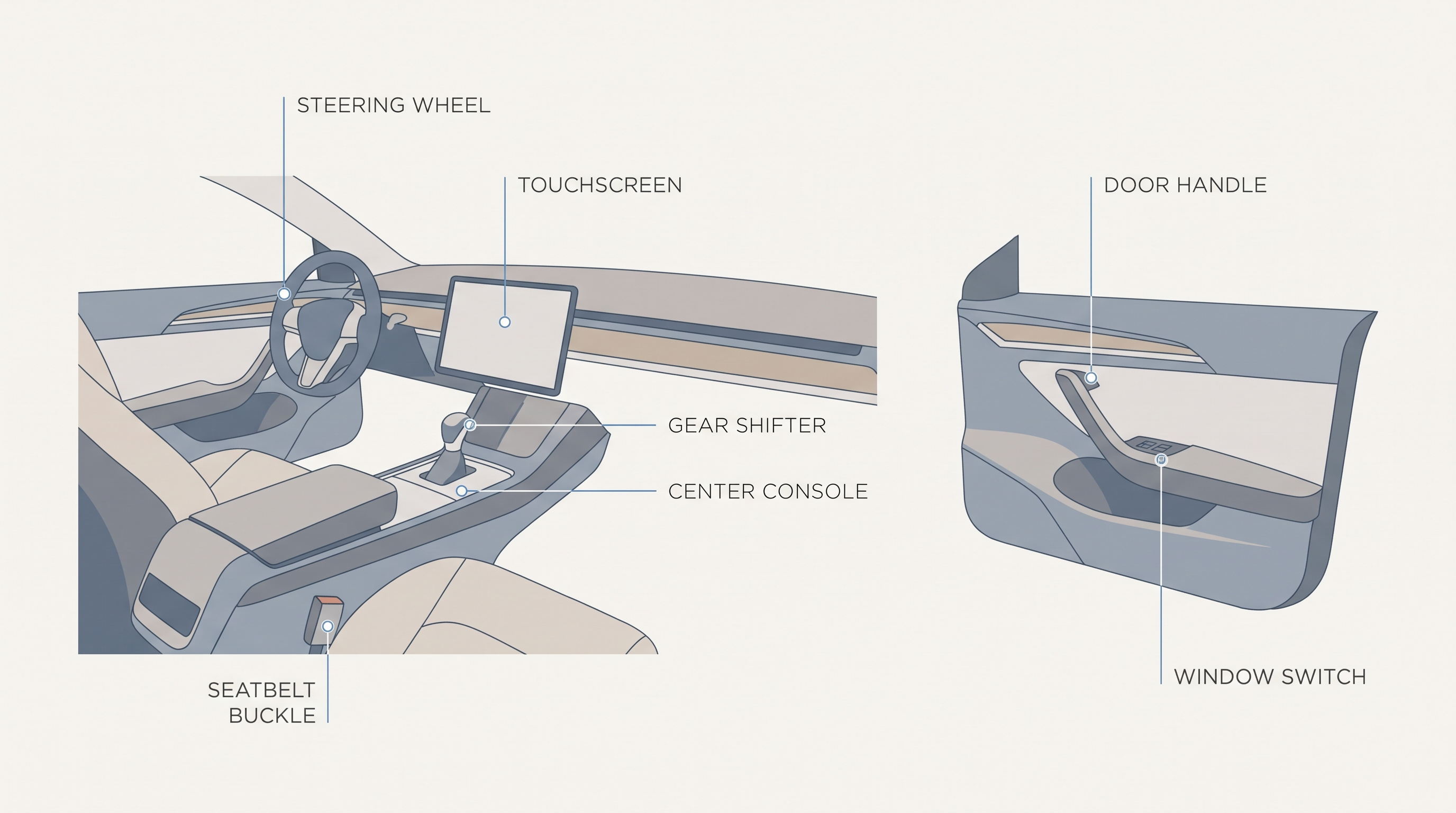
In a 2014 study published in the journal Biofouling, researchers swabbed 18 cars at 11 different interior locations and described the cabin as an environmental reservoir: a place where the bacteria from your skin, nose, and mouth collect and linger, especially on the controls your hands grip on every trip. The locations they tested read like a map of everywhere a driver's hands go: the steering wheel, the gear shifter, the radio knob, the center console, the door handles and locks, and the window and cruise-control switches.
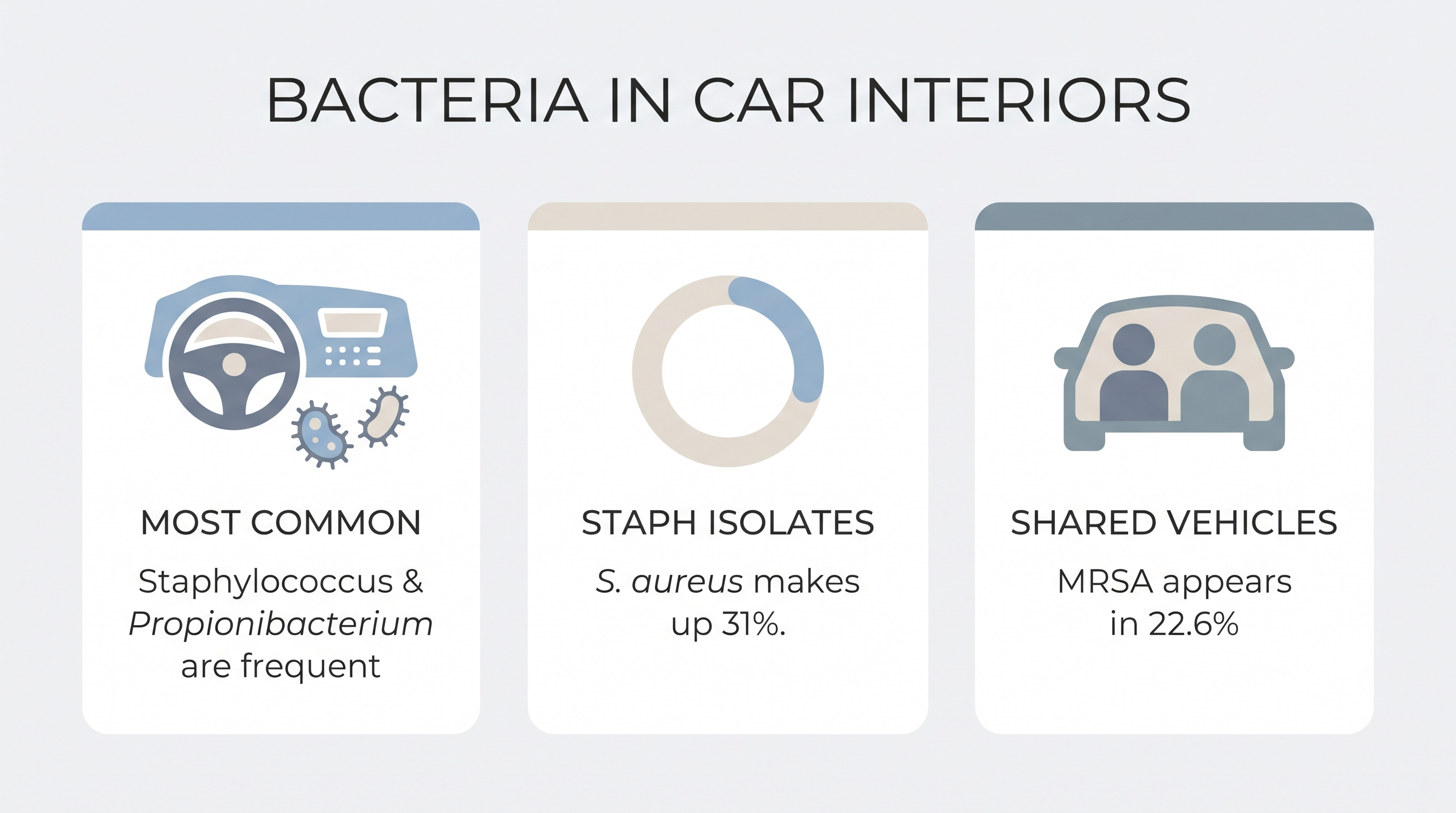
What they found was strikingly consistent. Nearly everywhere they sampled, the two most common types of bacteria were Staphylococcus and Propionibacterium, both of which live naturally on human skin. The inside of a car, in other words, mostly holds the bacteria you yourself carried in on your hands.
What actually collects on a steering wheel
This is the part that surprises people. Among the Staphylococcus bacteria the researchers cultured, three species accounted for close to nine out of every ten isolates: S. epidermidis at 43 percent, S. aureus at 31 percent, and S. warnerii at 13 percent. S. epidermidis is mostly harmless skin flora. S. aureus is the one worth paying attention to, because some strains cause real skin and respiratory infections, and because a meaningful share of it no longer responds to common antibiotics.
That last point showed up clearly in the same study. When the researchers looked at shared community cars, 22.6 percent of the S. aureus they found was methicillin-resistant, which is the definition of MRSA. None of this is a reason to panic. It is a reason to stop treating the car as a naturally clean place.
A more recent study from Aston University reached a similar conclusion from a different angle. Swabbing used cars, the researchers found up to 55 different germs per square centimeter, and counted bacteria by area: the trunk was the dirtiest spot tested at 1,425 bacteria, followed by the driver's seat at 649 and the gear shifter at 407. The steering wheel came in lower, at 146, which the researchers partly credited to people sanitizing their hands more since 2020. The same study detected E. coli in most of the trunks and on some driver's seats, a reminder that what walks onto your shoes and bags does not always stay on the floor.
The high-touch map: the spots you grab every trip
If you want a short list of where to aim, it is the same short list every driver touches dozens of times a day:
- The steering wheel - hands, sneezes, and phone transfers all land here first.
- The gear shifter and drive-mode buttons - the Aston study's third-most-colonized area, at 407 bacteria.
- The door handles, inside and out - touched by every passenger, including the hand that just pumped gas.
- The window and mirror switches - small, textured, and almost never wiped.
- The touchscreen and climate controls - fingerprints build a film that bacteria readily settle into.
- The seatbelt buckles and release buttons - handled at the start and end of every single trip.
The Biofouling researchers flagged the same pattern. The most heavily colonized spots in their testing, with more than 100 culturable bacteria per swab area, were the steering wheel, the gear shifter, the door handles, the window switches, and the center console near the cup holder. That is the map, and the good news is that it is short.
Why a wipe only gets you halfway
Disinfectant wipes are genuinely useful, and clearing visible dirt off a surface is the right first step every time. But a flat wipe on a textured surface runs into a geometry problem. A steering wheel is covered in stitching, seams, perforations, and a grip pattern designed to stop your hands from slipping, which is precisely why it also stops a flat cloth from reaching the bottom of every groove. The same is true of the seams on a gear shifter and the gaps around a row of climate buttons.
UV-C light approaches the problem from a different direction. Rather than pressing into a surface, it treats whatever the light can reach directly. The International Ultraviolet Association explains that UV-C in the 220 to 280 nanometer range, and especially around 254 to 265 nanometers, disrupts the DNA and RNA inside microbes so they cannot reproduce and spread. The word that matters is dose: disinfection is a product of how intense the light is and how long it stays on a spot. That is why distance and dwell time matter far more than how bright a device looks, and why a slower pass over each area beats a fast wave across the whole cabin.
There is an honest catch built into the physics, and it is worth saying out loud. UV-C does not pass through materials and does not turn corners. It is a line-of-sight, surface treatment, and anything shaded or recessed receives little or no dose. That is not a flaw to hide. It is the reason a good routine treats each surface straight on and moves slowly enough to finish the job.
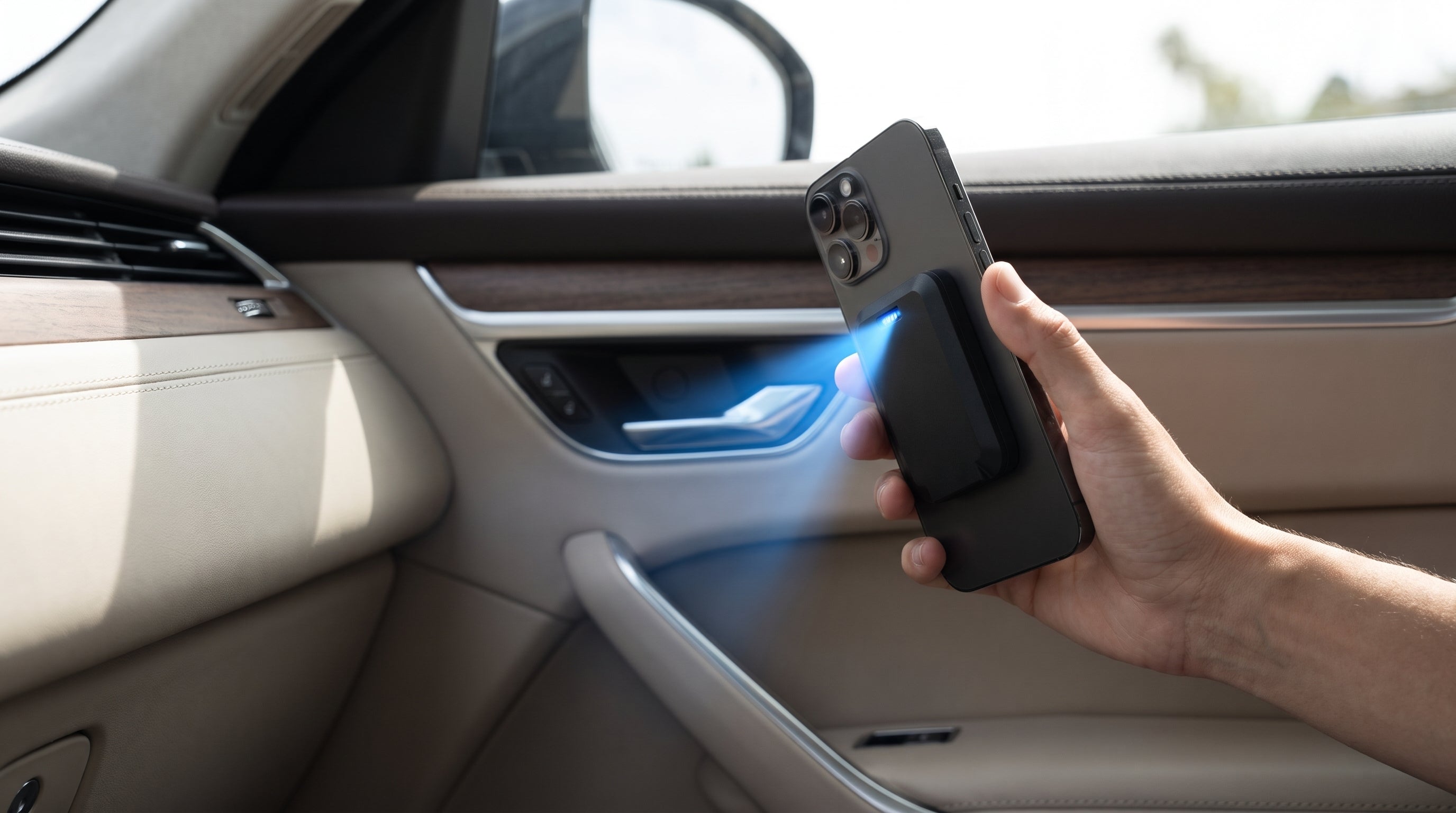
AI-generated illustration for visualization purposes. UV-C light is invisible to the human eye.
How a guided device changes the routine
This is where the difference between "wave a light around" and "actually finish" shows up. UVCeed is a UV-C disinfection device that attaches to your phone, and its app uses the camera to show you, in real time, which areas of a surface you have covered and which you have missed. It turns a guess into something you can see: the surface on screen, with an overlay marking what is already done, so you are not relying on memory or hope.
On clean, hard, nonporous surfaces in independent lab testing, the device reduced Staphylococcus aureus by 99.9 percent in 15 seconds and E. coli by 99.99 percent in 24 seconds. The company is careful to note that results apply to tested conditions and that visible soil should be cleaned away first. Light reaches surfaces, not crumbs, so wiping and UV-C work together instead of replacing one another.
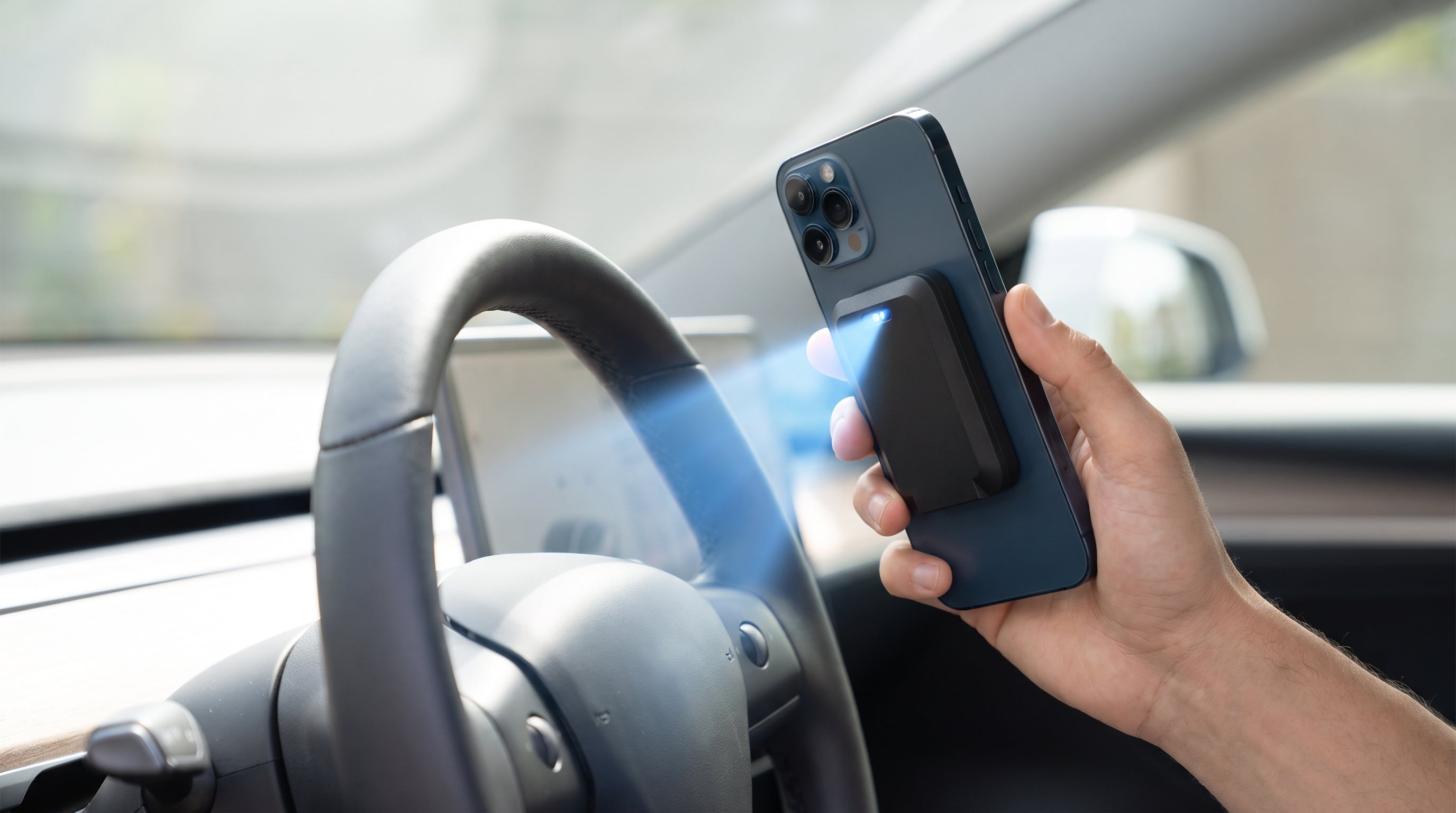
AI-generated illustration for visualization purposes. UV-C light is invisible to the human eye.
If your car is the room you touch most and clean least, a tool that shows you the finish line beats another blind pass with a cloth. See how UVCeed disinfects the surfaces you touch every day.
A simple order for a ten-minute clean
You do not need to detail the car like a showroom every week. A short routine, done in the right order, covers the surfaces that actually matter:
- Remove the obvious first. Brush or vacuum away crumbs, dust, and debris. UV-C treats surfaces, not a layer of dirt sitting on top of them.
- Wipe what is wet or sticky. Clear visible grime off the wheel, shifter, and screens with a dry or lightly damp cloth before disinfecting.
- Treat the touch points with UV-C. Work in a steady order: steering wheel, gear shifter, door handles, window switches, center console, and seatbelt buckles. Let the device tell you when each area has reached the right dose.
- Finish with the things that ride along. Your phone, keys, and water bottle pass through the car constantly. Treat them in the same session, since they are already in your hand.
Ten minutes, once a week, covers the surfaces that carry the most bacteria. Do it more often if you eat in the car, transport pets, or share the vehicle with a house full of people.
Make it a habit that fits
The reason most people skip the car is not laziness. It is that cleaning it feels like one big, vague project. So shrink it. Attach the routine to something you already do, like filling the tank or Sunday before the week starts, and keep the device where you will actually see it, in the glove box or the center console, rather than in a drawer back in the house.
Your car is one of the few rooms you occupy every day without ever thinking of it as a room. A little attention, aimed at the handful of surfaces your hands actually touch, is all it takes to close the gap between how clean it looks and how clean it actually is.
One weekly pass over the surfaces you already touch is the difference between a car that looks clean and a car that actually is. Get the UVCeed disinfection device.
Want More Articles Like This?
Get research on UV-C treatment and product updates delivered to your inbox.


